
How Hidden Cameras Work (And How They Stay Hidden)
This guide explains the different types of hidden cameras, how they transmit or store footage, how they are powered, and why simple detection methods often miss them.
Quick Answer
- Hidden cameras can be wired, battery-powered or fully self-contained
- Some transmit live video, others record internally
- Many are disguised inside everyday objects
- Not all devices emit detectable signals
- Detection depends on how the device is built and used
Types of Hidden Cameras
Hidden cameras are not all the same. The way they operate depends on how they are designed and what they are intended to do.
- Battery-powered cameras – small, self-contained and easy to place
- Wired cameras – connected to power for long-term operation
- WiFi cameras – transmit video over a network
- Recording-only cameras – store footage internally without transmitting
Each type has advantages depending on how discreet or long-term the setup needs to be.
Transmission vs Storage
One of the most important differences is whether a device transmits data or stores it locally.
Some cameras send video in real time using WiFi or mobile networks. These can sometimes be identified through network analysis or signal detection.
Others record directly to a memory card. These devices may not transmit anything at all, which makes them much harder to detect using basic tools.
This is why checking WiFi alone will not identify every hidden camera.
Power Sources
Every hidden camera needs power, but how it gets that power varies.
- Internal batteries for short-term use
- Rechargeable batteries for repeated use
- Hard-wired connections for continuous operation
- USB or mains-powered devices disguised as chargers or electronics
Power requirements often influence where a device is placed. Long-term setups are usually connected to a power source, while temporary setups rely on battery power.
Why Hidden Cameras Are Hard to Detect
Modern hidden cameras are difficult to detect because they are designed to avoid obvious signs.
- They are small and easily concealed
- They may not emit signals continuously
- Some do not transmit at all
- They are built into everyday objects
- They can be positioned in logical, non-obvious locations
Many basic detection methods rely on finding signals or obvious visual indicators. If a device is not transmitting or is well concealed, it may not be detected with simple tools.
Common Disguises
Hidden cameras are often built into objects that naturally belong in the environment.
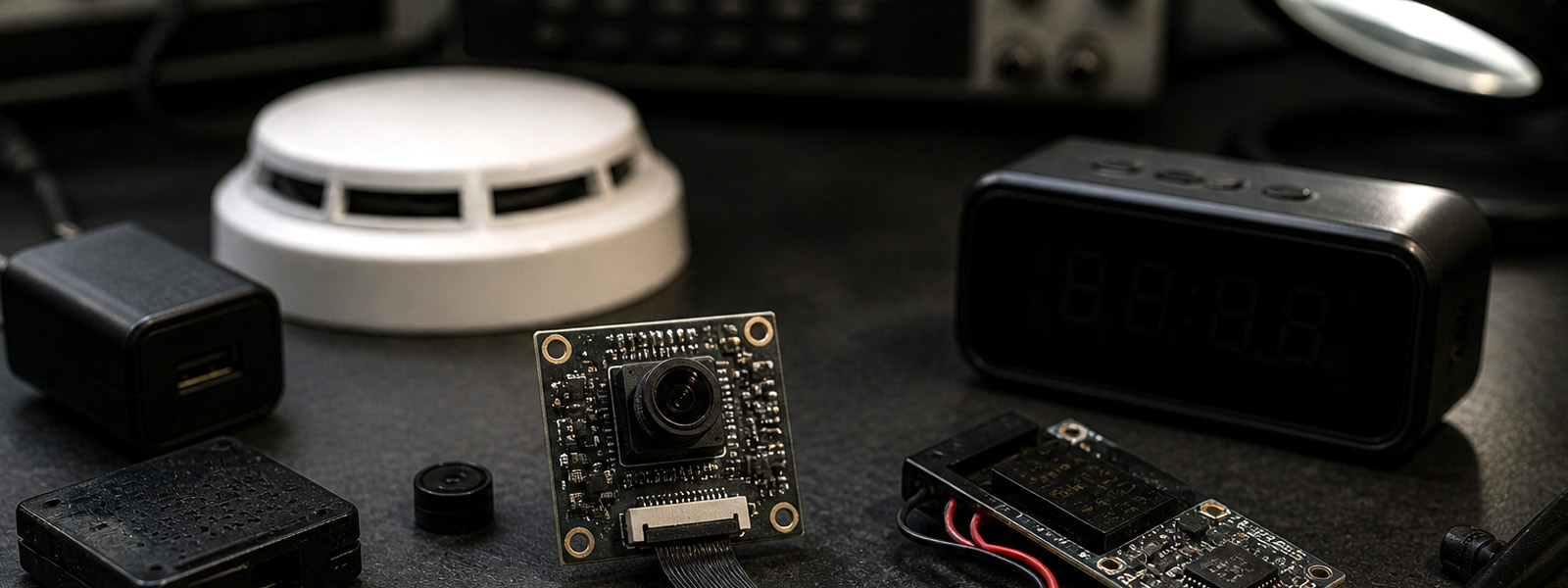
- Smoke alarms and ceiling sensors
- USB chargers and power adaptors
- Alarm clocks and bedside electronics
- Air fresheners and decorative items
- Wall-mounted devices and fixtures
The goal is to avoid drawing attention. If an object looks normal and is in a logical position, it is less likely to be questioned.
The Limits of Basic Detection
Simple detection methods can help, but they have limits.
Phone apps, WiFi scans and low-cost detectors may identify some devices, particularly those that are actively transmitting. However, they can also miss devices that are inactive, recording internally or operating outside the range being checked.
This can create a false sense of security if relied on as the only method.
Why Proper Equipment Matters
Detecting hidden cameras properly requires a structured approach and the right tools. This may include RF analysis, thermal inspection, lens detection and physical inspection techniques.
No single tool will find every device. It is the combination of methods and the way they are used that makes the difference.
If you are concerned about hidden cameras in a home or workplace, our Home Sweeps and Business Sweeps services can inspect the environment and explain what is found.
Final Thoughts
Hidden cameras are not always easy to detect, but understanding how they work makes it easier to assess the risk.
Most environments are not under surveillance. When concerns do arise, focusing on how devices operate is the first step in understanding what is realistic and what is not.
Common Questions
Do all hidden cameras use WiFi?
No. Some transmit over WiFi, but many record internally without using any network.
Can hidden cameras work without power?
No. All cameras require power, but this can come from batteries, wiring or external sources.
Are hidden cameras easy to detect?
Not always. Detection depends on how the device is built and whether it is transmitting.
Do hidden cameras always have a visible lens?
Yes, but it may be very small and difficult to notice without close inspection.
Can phone apps detect hidden cameras?
They can help in some cases, but they are not reliable enough to detect all devices.